

Lens implantation is considered one of the best treatment options for patients who are not suitable candidates for laser vision correction. If your doctor informs you that laser technology cannot treat your eyes, this is not the end of the road—lens implantation offers a more effective solution with significantly better visual quality.
Let us explore this procedure in detail from the perspective of Dr. Sherif Momtaz Hegazy’s Center, where the most advanced lens types are used to fully correct refractive errors.
Lens Implantation for High Vision Correction
Lens implantation for high refractive errors is an innovative medical procedure in which corrective lenses are fixed inside the eye.
These lenses help treat all types of visual problems, primarily:
- Myopia (nearsightedness)
- Hyperopia (farsightedness)
- Astigmatism
In some cases, the natural lens is left in place and the new corrective lens is implanted in front of it. In others, the damaged natural lens is removed and replaced entirely with an artificial lens.
Lens implantation can achieve highly accurate visual correction, reaching:
- –0.5 up to –18 diopters in myopia
- 0.25 up to 6 diopters in astigmatism
ICL Lenses for Vision Correction
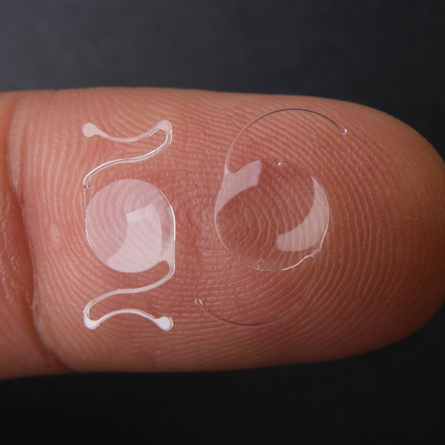
Lens implantation for high refractive errors relies on several types of therapeutic lenses, the most prominent being ICL (Implantable Collamer Lens).
These lenses are extremely thin, soft, and flexible artificial implants placed inside the eye to correct advanced refractive errors.
They sit behind the iris and in front of the natural lens.
ICL lenses are made of biocompatible, non-reactive materials that do not cause fibrosis, immune rejection, or discomfort—even after many years. They are inserted into the eye in a folded form and unfold naturally inside.
They are not affected by heat, physical effort, eye inflammation, or other conditions.
An important advantage is that ICL lenses are removable, if needed—for example, in cases of cataracts, elevated intraocular pressure, or any medical reason requiring lens removal.
Contact us now – WhatsApp available
Important Instructions Before Lens Implantation Surgery
At Dr. Sherif Momtaz Hegazy’s Center, all diagnostic measures are taken to ensure that lens implantation is the best and safest option for each patient.
Alongside thorough examinations, several key pre-operative recommendations are provided:
- Stop using blood-thinning medications (e.g., aspirin, clopidogrel) after consulting your doctor.
- Quit smoking before and after the surgery, as smokers require longer healing time.
- Bring a companion on the day of surgery since your eyes will be covered with medical dressings.
- Avoid food and drink for at least 12 hours before the surgery.
Lens Implantation Surgery for High Vision Correction
This procedure is considered simple and highly successful.
It is performed in approximately 20 minutes, under local or general anesthesia.
The surgery resembles the concept of contact lenses, except that instead of wearing external lenses or glasses with a corrective power, the corrective lens is implanted inside the eye permanently.
Surgical Steps
- Instilling anesthetic eye drops.
- Sterilizing the eye and surrounding skin to prevent infection.
- Using an eyelid speculum to keep the eye open during the procedure.
- Creating a very small incision (2–3 mm) using a laser or microkeratome.
- Preparing and folding the artificial lens to insert it through the incision.
- Positioning and fixing the lens behind the iris and in front of the natural lens.
- Applying a medical bandage for one full day to promote healing.
Post-Operative Instructions After Lens Implantation
These instructions are essential for achieving the best results:
- Use prescribed antibiotic, anti-inflammatory, and lubricating drops as directed.
- Avoid makeup for at least one week and avoid creams around the eyes.
- Prevent water from entering the eyes (washing, showering, swimming).
- Avoid wearing colored lenses for one month.
- Control sneezing, coughing, vomiting, and constipation as much as possible.
- Avoid bending forward, bowing, or lowering your head.
Contact us now – WhatsApp available
Advantages of Lens Implantation for Vision Correction
Lens implantation is an excellent option for treating all types of refractive errors. While glasses provide good correction, and contact lenses provide even better results, permanent implantable lenses offer the highest quality of vision.
Key advantages include:
- Correcting myopia beyond –12 diopters.
- Suitable for patients with thin corneas, who cannot undergo laser procedures.
- Correcting hyperopia above +5 diopters.
- Lenses remain stable inside the eye without daily care or cleaning.
- No visual distortions like those caused by glasses.
- No risk of immune rejection.
- Permanent results that typically last a lifetime.
- Lenses can be replaced or removed if necessary.
- Extremely short surgical time (about 20 minutes).
- No effect on corneal nerves—therefore, no risk of dry eye.
Disadvantages of Lens Implantation
Although complications are very rare—especially in the care of Dr. Sherif Momtaz Hegazy—they must still be mentioned:
- Increased eye pressure, potentially leading to glaucoma.
- Temporary blurry vision, halos around lights, and difficulty driving at night.
- Infection due to poor sterilization or not following medical instructions.
- Lens displacement requiring minor adjustment.
- Development of cataracts in older patients.
- Rare bleeding in the cornea or retina.
- Higher cost compared to laser surgery.
Who Is a Suitable Candidate for Lens Implantation?
This procedure is ideal for the following patients:
- Ages 22 to 45
- Severe myopia
- Severe hyperopia
- Astigmatism
- Presbyopia (age-related farsightedness)
- Significant corneal thinning
- Post-cataract removal cases
Contact us now – WhatsApp available
Types of Implantable Lenses
Different lenses are used depending on the patient’s condition. At Dr. Sherif Momtaz Hegazy’s Center, the top lens types include:
1. Monofocal Lenses
Correct vision at one focal distance (near or far).
Suitable for driving, TV watching, and reading (sometimes used with glasses).
2. Multifocal Lenses
Correct vision at all distances.
Provide complete freedom from glasses.
May cause slight halos around lights.
3. Extended Depth of Focus (EDOF) Lenses
Provide excellent distance vision and improved intermediate vision.
May still require reading glasses for close work.
4. Secondary Corrective Lenses
Used for young patients with high myopia or thin corneas.
The corrective lens is implanted without removing the natural lens.
5. Toric Astigmatism Lenses
Correct astigmatism caused by irregular corneal curvature.
Difference Between LASIK and Lens Implantation
Lens implantation corrects vision without removing any corneal tissue, using a safe artificial lens placed behind the cornea.
LASIK, however, reshapes the cornea using a laser, which may not be suitable for thin corneas and can worsen corneal thinning.
Thus:
- Lens implantation preserves all parts of the eye
- LASIK removes corneal tissue
For patients with thin or weak corneas, lens implantation is the safest alternative.
Contact us now – WhatsApp available
Best Vision Correction Specialist in Egypt
Lens implantation for high refractive errors is one of the key procedures performed at Dr. Sherif Momtaz Hegazy’s Center.
Dr. Sherif Momtaz Hegazy is widely recognized as the best ophthalmologist in Egypt and the Middle East.
His distinguished background includes:
- Bachelor’s degree in Medicine, Cairo University
- Master’s and Doctorate degrees in Ophthalmology, Kasr Al-Ainy
- International Examiner for the Royal College of Surgeons (UK)
- International lecturer highly sought after by ophthalmology trainees
- Recipient of a global fellowship from the World Ophthalmology Council
- Advanced surgical fellowship in retinal and vitreous surgery at Tübingen University, Germany
- Member of major international medical institutions, including:
- Tübingen University – Germany
- Royal College of Surgeons – UK
- World Ophthalmology Council
- Research Institute of Ophthalmology – Egypt
He has authored numerous scientific publications in leading global journals, and his medical center is now one of the top destinations for patients seeking treatment for refractive errors, corneal diseases, retinal conditions, and all eye surgeries.